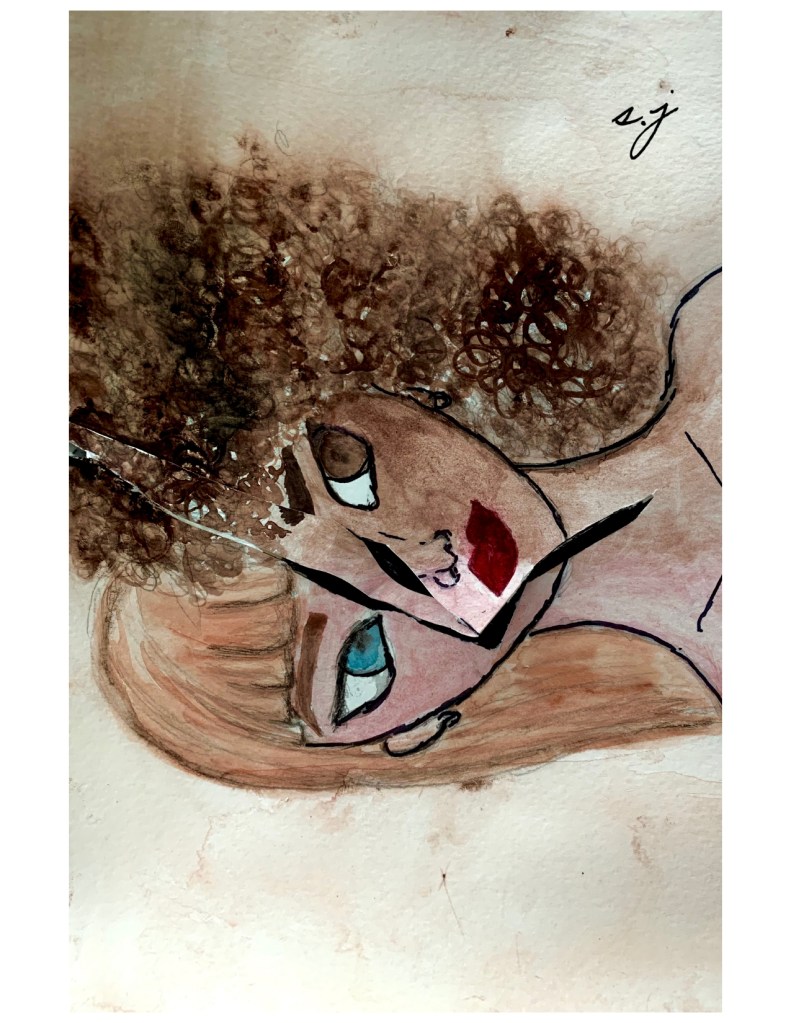
Darkness and Light
Both in eternal battle
Both coexisting

Neither one better than the other
The battle will last a lifetime

For without light we cannot see the flowers
And without dark there are no stars

Light and dark.
Both powerful.
Both deserving.
Both beautiful.

Meet me in the field of flowers and let’s dance under the starry night

-S.J
2020 has been anything but easy. Everywhere we look there is destruction, the spreading of disease, the loss of human life. Although the tensions regarding COVID-19 are winding down, something more toxic has entered the global community. This new virus tends to target its victims in a more physical way, often through the use of force, without any sympathy or patience. Some of you may have already heard the name of this virus. It popped up a couple of times on your social media page accompanying brutal videos.
Is it ringing any bells? What if I gave you an example? – Remember George Floyd crying, “I can’t breathe?” I know you remember now!
In this example, both COVID-19 and this “new-ish” virus resulted in the exact same symptom; respiratory distress. But what’s funny is that COVID-19 seems to be the more sympathetic perpetrator of two. While Derek Chauvin pressed his knee into George Floyd’s neck, failing to hear him out, refusing to understand him, COVID-19 obtained an in-depth perception of its targets. The virus studied the physiology of its victims, it obtained control of the cells machinery, reviewed the nooks and crannies of our being…slowly incubating before the final attack. A blob of genetic material showed more compassion than a human being who had the capacity to analyze the situation and make a choice. Racism is not old news. It is a pervasive and sickening reality that we have been conditioned into.
Our racial attitudes and schemas can impact the health of ethnic minority groups through both direct and indirect mechanisms. A study done by Williams and Williams-Morris identified three major pathways by which this occurs: (1) Institutional discrimination as a barrier to progressing in social standing (socioeconomic status/SES), (2) Discrimination as a stressful experience that negatively impacts mental health and (3) Minority groups accepting the negative attributions assigned to them by society, which then alter psychological functioning.
DISCLAIMER
I would love to expand more on each of the components analyzed in the study and there is so much more to say on this subject, however, to keep this from getting too long I will only be analyzing institutional discrimination. The goal of this is just to provide a simple definition on a rather complex topic for those who are not too familiar with the term and to explain the consequences of this practice. Although I am no expert on the topic of racism, I understand the complexity of the subject and respect the works of individuals who have studied it in much more detail. I also recognize that racism is a rather broad topic with many subcomponents, all of which require dedicated studying in order to fully address the matter. My intent is to slowly gain an understanding of the subcomponents so that I can get deeper knowledge on the subject and resolve these issues in my personal life with the appropriate measures.
INSTITUTIONAL DISCRIMINATION:
“Institutionalized racism is defined as the macrolevel systems, social forces, institutions, ideologies, and processes that interact with one another to generate and reinforce inequities among racial/ethnic groups”
This is the system setting certain individuals up for failure by limiting their access to opportunities. A society burdened with this inscription is characterized by higher unemployment rates, large differences in educational attainment and major differences in income for minority groups. The study by William and Williams-Morris showcased disparities at every level of income when comparing African-Americans and Caucasians. Furthermore, data from the US Bureau of the Census (1998) showed that compared to the black minority, the white population had a median net-worth that was 10x larger.
Living in a society that isolates individuals from access to stable work opportunities, social networks and role models, leaves that community to suffer. It limits individuals from escaping cycles of poverty and imprisons them in a life surrounded by stigma. Long term exposure to the high stress accompanying these communities can then diminish academic success and work ethic, leading to economic failure in the future.
Dismantling these unequal networks is essential for improving the SES of minority groups because the differences in SES can have a tremendous impact on mental health. We as a community, who are privileged, whether that means holding a powerful position at your job, having a large fan-base or being financially well off, have a responsibility here. When we stay silent in the face of institutionalized racism, or racism in any setting, we become the perpetrators ourselves. This makes us no different than the police officer who showed no mercy in hearing the plea of an innocent man. We are not this person, nor do we want to be. Staying silent, or promoting acts that diminish minority groups cannot be justified by any means. It is our job to speak to those around us and break this train of thought that we have been conditioned into. This may mean posting on social media for some, or speaking directly to those around you (in my personal opinion, the latter is the most effective because it leaves a much bigger impact and is more memorable than a post). At the end of the day, we all have a job here and it is to protect those who cannot protect themselves.
1. Hardeman, R. R., Murphy, K. A., Karbeah, J., & Kozhimannil, K. B. (2018). Naming Institutionalized Racism in the Public Health Literature: A Systematic Literature Review. Public health reports (Washington, D.C. : 1974), 133(3), 240–249. https://doi.org/10.1177/0033354918760574

2. David R. Williams & Ruth Williams-Morris (2000) Racism and Mental Health: The African American experience, Ethnicity & Health, 5:3-4, 243-268.DOI: 10.1080/713667453
 The Layman's Land