 I am passion.
 So free and melodically wild
 More vibrant than what you think you see.
 With an ounce of my grace
 Your weak heart will lust
 And chase after me.
 But you can never capture my wandering spirit.

 Structure. Solidity. Accuracy.
 Lay within my textured surface.
 Between every groove and hill
 I hide my genius.
 My memories.
 My elegant use of tongues.
 My knowledge -soaring, penetrating,
 Limitless.

 Braided in my desire and glory
 Encapsulated in my intricate linings
 I scream for your attention.
 But you claim you only hear a whisper.
 For to be heard is one thing,
 But to be understood…

 That my friend, is something else.

~Sharon Joseph
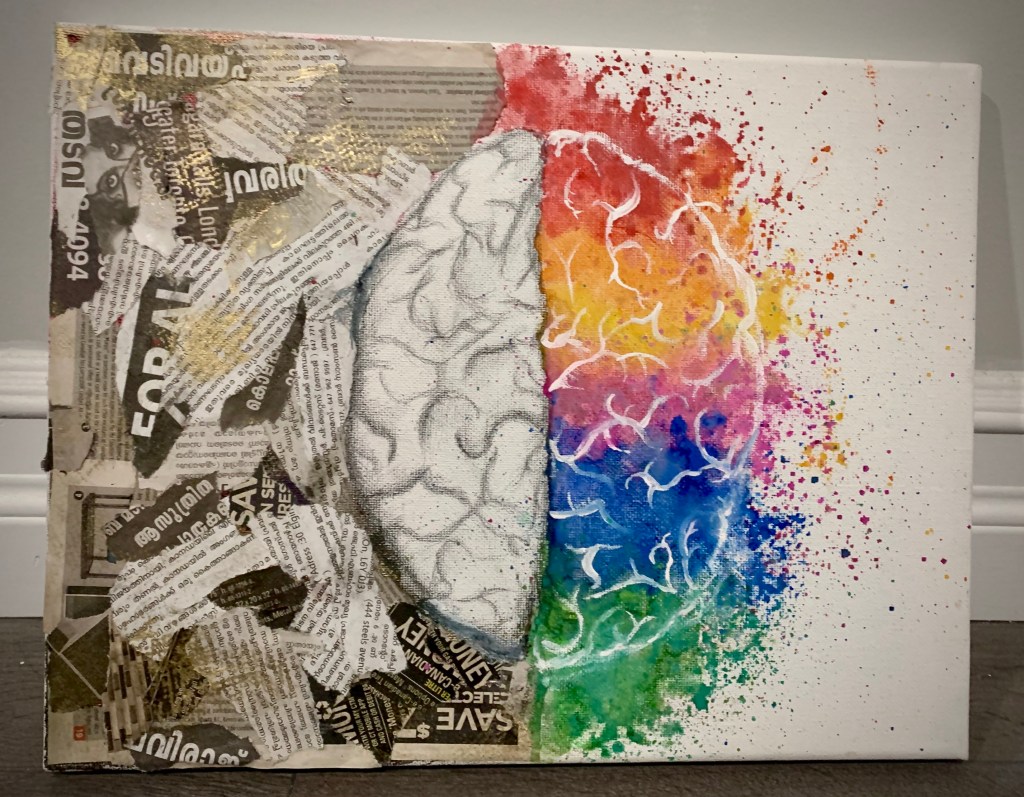
This is a piece I wrote on the asymmetry of the brain to portray the general differences between the left and right hemisphere. This poem emphasizes a more extreme split between the two hemispheres, as studies have shown that some functions may be processed predominantly in one hemisphere over the other (Raemaekers et al. 2018). This does not mean that only the left hemisphere processes language functions or that only the right hemisphere cares about emotional functioning; rather, it is a more collaborative system that the two hemispheres create.
Generally, both of the hemispheres are very similar to each other in their representation. The left part of the brain interprets and controls movement on the right side of the body, while the right hemisphere controls the left side of the body (Raemaekers et al. 2018). But there are some really cool features that are specialized within each hemisphere. For example, in most right handed individuals, the left hemisphere shows a dominance for understanding and producing language. On the other hand (literally), left handed individuals show a larger likelihood of showing right hemisphere dominance than right-handers. The general trend is that the more right-handed the individuals are, the lower the likelihood of right hemisphere dominance for language (Knecht et al. 2000).
The right hemisphere is described in the poem as the being the creative, wild side of the brain. This hemisphere is seen to be the one that is more strongly activated in functions like emotional processing, facial recognition and non-verbal communication. Even when generating certain emotions, the left side of the face is seen to move first/faster than the right since it is controlled by the right hemisphere (Corballis 2017).
We may have evolved to develop these preferences for a variety of reasons. Maybe having one hemisphere in charge of speech production would get rid of the competition between the two hemispheres and would make communication more efficient, or maybe its faster to process information in one area before distributing it everywhere else. Regardless of how and why, the brain is an intelligent organ that deserves to be appreciated for its strategic way of handling all the information we keep throwing at it. It’s natural ways of coping with all these factors could actually inspire us on how to handle our own situations.
References:

1. Corballis, M. C. (2017, June 16). The Evolution of Lateralized Brain Circuits. Retrieved from
https://www.ncbi.nlm.nih.gov/pmc/articles/PMC5472687/.
2. Raemaekers, M., Schellekens, W., Petridou, N., & Ramsey, N. F. (2018, May). Knowing left from right: asymmetric functional
connectivity during resting state. Retrieved from https://www.ncbi.nlm.nih.gov/pmc/articles/PMC5884915/.
3. Knecht, Deppe, Bobe, Lohmann, Ringelstein, & Henningsen. (2000, December 1). Handedness and hemispheric language dominance in
healthy humans. Retrieved from https://academic.oup.com/brain/article/123/12/2512/325690.
 The Layman's Land