A Fools View
How dare you judge me
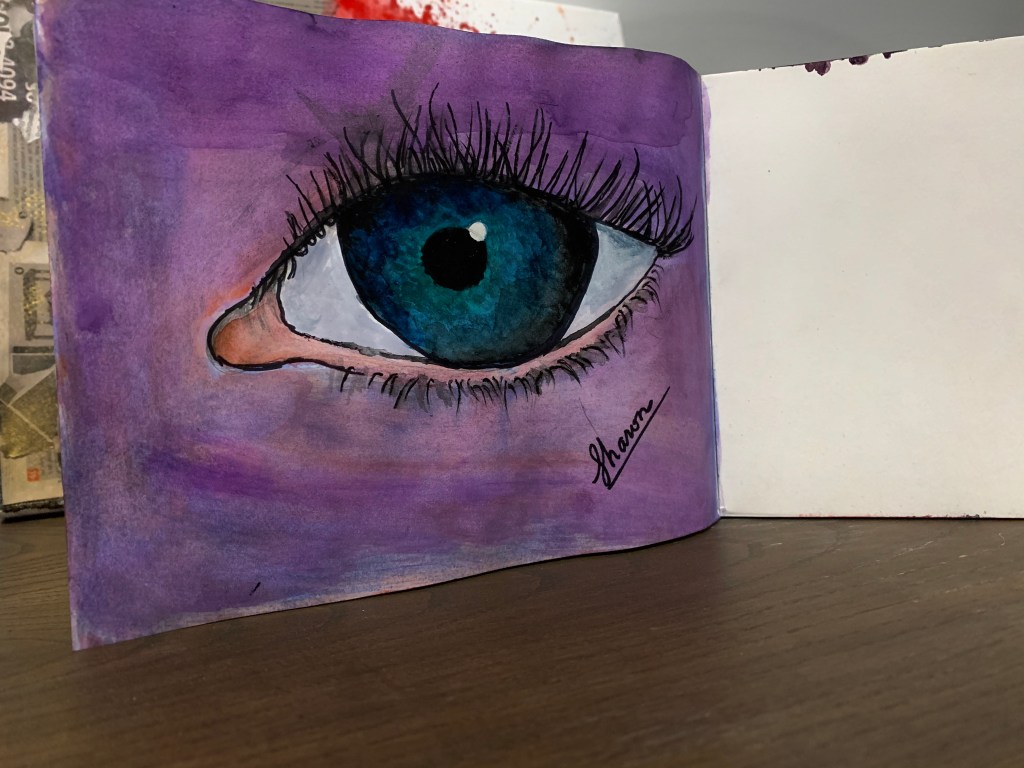
Through those deep blue oceans
Are we not the same
You and I?

Thrones crested in gold
Is where you held yourself
And you gave me nothing
But a raggedy old stool to lay in the darkness you’ve conjured up for me.

But I’m here to tell you that you and I,
We are not so different.
When our clocks stop ticking and our bodies become engulfed by the soil you so proudly walked upon...you will think of ME.

You will remember my title which you so easily destroyed.

You will remember how quickly you ripped apart my character.

We will become one with the earth and my soul will spread over yours. My identity, bleeding through the soil which we share.

You will finally see me.

The real me.


~ POV: everyone you’ve ever met
Have you ever had that moment when you are driving and someone zooms right past you? All of a sudden you start creating different reasons for why they could be driving this fast. You may even go as far as calling them a maniac to justify their actions. Now let’s turn the tables. Imagine waking up one day to write your final exam and finding out that you woke up with 15 minutes to get to your exam location. Obviously you run out of your house in your PJ’s and hit the gas because you know that it takes you 30 minutes by car to get there. Now you’re the maniac speeding through the highway. But this time you know the story… you’re not crazy! You are simply driving as fast as you can so you can go kill that exam that’s been killing you the entire semester. But this is not how others see it. What we have here is a phenomenon known as the fundamental attribution error.
Fundamental attribution error is the tendency to attribute peoples behaviours to a personal trait and overlook the situational factors that may have contributed to that behaviour (1). We are able to experience our emotions and understand our thoughts and sensations. This allows us to judge our actions from a deeper and more internal perspective. But our experience of others is based off what we see externally and through their overt behaviours (2). This might explain why we rate ourselves as more positive and more considerate than others would rate us (2).
Another example is when we watch something on TV and attribute character traits to the individual actors on a show. We are very aware that there is a script that the actor has to follow, but there is an assumption that their traits on television will be reflective of how they are in reality. In a study done by Tal-Or and Papirman, they tested for the fundamental attribution error in participants by showing the same actor playing 2 completely opposing roles. The study showed that even though 2 completely different traits were expressed in the 2 scenes, the fundamental attribution error still occurred. Additionally, whichever role the actor played in the last scene was the one that determined how the participants evaluated the actor’s character traits (1). Once again we have a scenario where we overlook the situation and attribute the behaviour to a personal trait.
Does this mean we are selfish and arrogant? Well, to be honest…yes. But we are all victims of this simple but tricky error. It is much easier to assume that someone is a maniac rather than going through a list of reasons as to why they are driving so fast. No wonder we judge so blindly! This leaves room for a lot of misunderstanding and conflict which can actually be avoided. So maybe it’s time to put ourselves in others shoes and be mindful of the fact that other peoples behaviours are also situationally constrained. Let’s not be too quick to judge.
1. Tal-Or, N., & Papirman, Y. (n.d.). The Fundamental Attribution Error in Attributing Fictional Figures' Characteristics to the Actors. Retrieved from https://www.tandfonline.com/doi/abs/10.1080/15213260701286049?src=recsys&journalCode=hmep20.
2. Pronin, E. (2008, May 30). How We See Ourselves and How We See Others. Retrieved from https://science.sciencemag.org/content/320/5880/1177/tab-pdf.
 The Layman's Land